



Case study: monthly revenue grew 5.4 x in three months
Sales Development and Lead Recovery reactivated stalled contacts and helped monthly revenue reach 5.4 x its starting level in three months.
Quick answer: how did monthly revenue grow 5.4 x?
A manufacturer of instruments and materials for medical and dental use combined Sales Development and Lead Recovery to qualify inbound demand, reconnect with historical contacts, define outreach cadences and improve handoffs to sales executives. Within three months, July monthly revenue was 5.4 x May revenue. With the same two-person SDR team, the team’s cost per new customer acquired fell by 86%.
Results at a glance
5.4 x
monthly revenue in July compared with May
38x
revenue generated relative to the investment in the SDR team over the period
−86%
cost of the SDR team per new customer acquired
60x
revenue generated relative to the SDR-team investment in July alone
The challenge: turning interest into sales opportunities
The company operates in the manufacture of instruments and materials for medical and dental use. Its portfolio includes technologies and solutions for digital dental workflows, helping professionals incorporate digital capabilities into clinical practice.
Although these technologies were attracting interest from dentists, the commercial operation faced a recurring challenge: connecting demand generated by campaigns, events, referrals and customer relationships to a consistent process for response, qualification and follow-up.
The CRM contained a substantial number of people who had already expressed interest. Nine out of ten of those contacts had never received structured outreach. Meanwhile, new leads were routed to different sales consultants without a standardized follow-up process, and open proposals often stalled.
The issue was not simply generating more demand. It was making better use of the audience the company had already reached and identifying exactly where each opportunity stopped moving forward.
The solution: connected people, processes and data
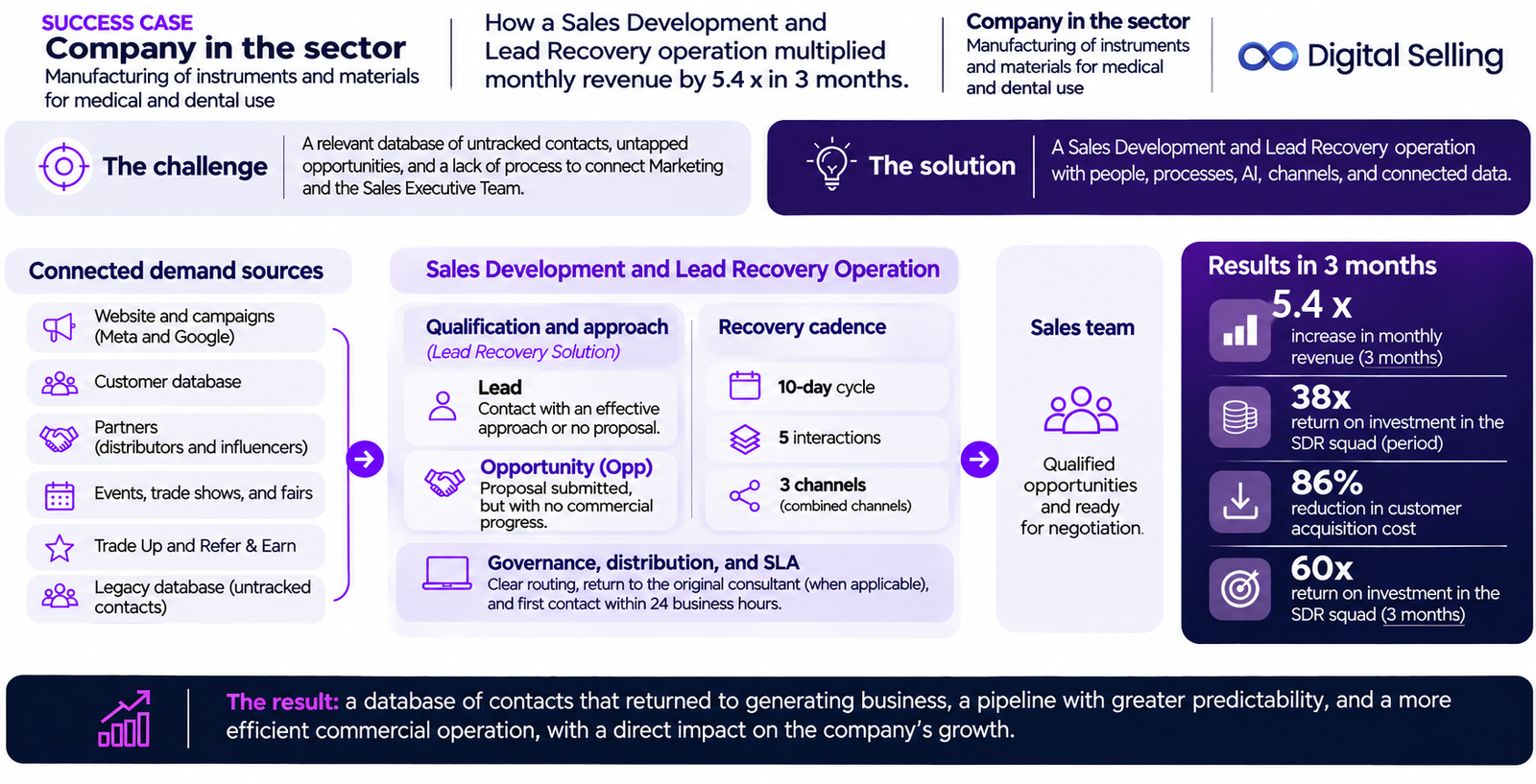
Digital Selling built a Sales Development and Lead Recovery operation with a dedicated team of two SDRs, a framework for recovering leads and sales opportunities, and governance across the commercial pipeline. The engagement combined Managed. Sales Development and Managed. Lead Recovery.
1. Clear pipeline stages and ownership
The operation distinguished between Lead—a contact who had not received effective follow-up or a proposal—and Opp—an opportunity with a proposal already presented but no further commercial progress. Each group received a recovery approach suited to its stage.
2. A structured multichannel recovery cadence
Using the Lead Recovery Solution framework, the team established ten-day cycles comprising five interactions across three channels. The workflow brought together existing demand sources, including the website, Meta and Google campaigns, commercial databases, events, congresses, referral programs, influencers, ambassadors and customer relationships.
3. Auditable lead routing and continuity
Lead handoff followed a straightforward rule: contacts who already had a consultant went back to their original representative; those without an assigned consultant were routed to the geographically closest one. The agreed first-contact window was up to 24 business hours.
Dedicated landing pages and a commercial follow-up function complemented the workflow, connecting lead qualification more closely with subsequent steps in the buying journey.
The results: growth with greater efficiency
May was the calibration month: the team organized the CRM, mapped the contact database and implemented its cadence. In June, revenue grew 268% compared with May, while the number of customers acquired increased 267%.
In July, revenue increased another 46% versus June, while the number of new customers doubled. Compared with May, July’s monthly revenue was 5.4 x higher, and the operation reached 96.55% of its monthly revenue target.
Higher productivity without expanding the SDR team
With the same two-person SDR team, the team’s cost per newly acquired customer fell 86% between May and July. Over the three-month period, generated revenue was 38 times the investment in that team; in July alone, the ratio reached 60 times.
The SDR team’s cost represented 2.6% of the revenue it generated over the period. These measures describe a revenue-to-team-cost relationship, not net profit or a company-wide customer acquisition cost.
The historical contact database began generating revenue again
After working only 10% of the legacy contact database, recovered contacts already accounted for nearly one-third of new customers acquired during the period. The operation also began closing deals across different regions of Brazil without relying exclusively on a local sales presence.
How to interpret these performance figures
Period: May through July 2026. The 5.4 x figure compares July’s monthly revenue with May’s. The 38x metric is the ratio of revenue generated to the investment in the SDR team for the three-month period, while 60x refers to July alone—not the three-month average.
The 86% reduction is in the SDR team’s cost per new customer, not necessarily the company’s full customer acquisition cost. These revenue-to-team-cost multiples are not net profit or independently audited financial ROI. Source: the project’s internal monthly and consolidated management reports; absolute values are withheld for confidentiality.
The next cycle of growth
The next phase focuses on three areas: activating the remaining 90% of historical contacts, recovering stalled proposals through an opportunity-specific cadence and improving the final stages of the commercial journey.
The experience shows what becomes possible when strategy, processes, ownership, people, data and technology operate together: growth is supported by a repeatable and measurable way of working rather than isolated efforts.
Frequently asked questions about Sales Development and Lead Recovery
What is the difference between Sales Development and Lead Recovery?
Sales Development responds to, understands and qualifies incoming interest before passing contextualized opportunities to sales executives. Lead Recovery reconnects with leads or opportunities that expressed interest previously but stopped progressing.
How did the outreach cadence work?
The team followed a 10-day cycle with five interactions across three channels. Contacts without effective follow-up or a proposal were handled differently from opportunities that already had a proposal but had not advanced.
What does 5.4 x monthly revenue growth mean?
It means that July 2026 monthly revenue was about 5.4 x May 2026 monthly revenue. This is a historical comparison from one project; it is not a forecast or guarantee for other companies.
Is the 60x figure for the entire three-month period?
No. The 60x revenue-to-SDR-team-investment ratio applies to July only. The corresponding ratio for the full three-month period was 38x.
Why is the client’s name not disclosed?
The company is identified by its manufacturing segment to preserve confidentiality. The case provides relative metrics and process details without revealing absolute revenue or customer counts.
Read this case in another language: Português (Brasil) · Español (México).
How many opportunities are sitting idle in your CRM?
Digital Selling helps companies turn interest into sales opportunities and restart relevant commercial conversations. Explore Managed. Lead Recovery and Managed. Sales Development.
Transform growth into an intelligent system and grow beyond borders.